


They learned to walk.
Then they stopped letting go.
For many families, the challenge isn't teaching a blind child to take their first steps—it's finding the right mobility tool for building self-reliant walking as their world around them continues to expand.
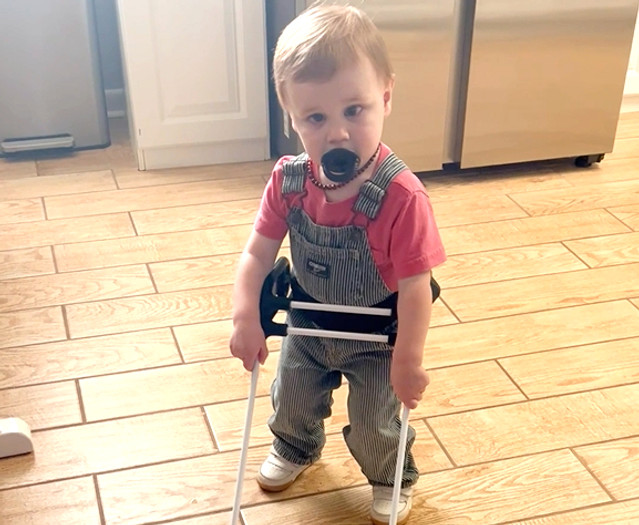
How it works: The cane frame guards their next step like their life depended on it, the belt helps them hold the white and red cane frame in place.
The Belt Cane
A Child's Mobility Tool for Improved Orientation & Mobility Outcomes
Children with a mobility visual impairment or blindness (MVI/B) wearing Pediatric or Big-kid Belt Canes use extended touch to know their next step.
HOW IT WORKS
Children with blindness gain self-reliance each time their next step is cleared by the Belt Cane's rectangular frame.
Children with a mobility visual impairment or blindness (MVI/B) can't rely on vision to move — they can rely on a mobility tool that ensures their next step has been checked for obstacles. The Belt Cane provides a vital connection to the path just ahead of the body.

Self-confident steps
Blind children trust the cane frame to help them find the best path for their next step.
01

Hands-free for playing
Blind children let go of external supports and helping hands and continue to feel secure.
02

Seeks out friends
Blind children independently start, stop, and change direction.
03

Built for your child
Sized for blind kids beginning around 12 months, growing into older childhood.
04
Stage 1

12-18 months
Belt Cane for learning to stand quietly and dance in the middle of the room. Explore nearby spaces. Walk with one handheld. Enjoy moving about.


Stage 2

As the world gets bigger
Every child deserves the freedom to explore with confidence. As environments become larger and more complex, the belt helps hold the cane frame in place.
Stage 3

Wearing the Pediatric Belt Cane most of the day
The cane frame shape claims the full path ahead. Its touch feedback allows them to build their self-reliance.


Stage 4

Beyond First Steps — A Lifetime of Independence
Children never outgrow the need to feel secure about their next step. From toddlers learning to walk to older children building independence, pediatric mobility aids like the Belt Cane support exploration through continuous touch feedback. Safe Toddles offers sizing guidance to help families find the right fit.
Pediatric mobility aids for confident, independent steps
We want to help you select the right Belt Cane. Follow our measurement guide or contact us for help.
GET A BELT CANE
Choose your next step.
We'll guide you through every stage — from sizing to funding to documentation.


THE GAP
Why common approaches fall short.
Hand-holding & guiding
Supports movement with an adult — but not independence. When the hand is gone, movement stops.
Furniture & wall walking
Offers temporary security, but limits exploration and keeps children at the edges of spaces.
Therapy-only time
Builds skills in sessions — but progress depends on repetition throughout the day.
Adult long canes
Designed for newly blind, employed adults — not for congenitally blind children who need to know whether their next step is safe, right now.

About Safe
Toddles
A 501 (C) (3) NONPROFIT
Safe Toddles was founded to address a gap many families experience early in a blind or mobility visually impaired child's development: self-reliant movement.
For children with a mobility visual impairment or blindness, touch is their primary sensory source for orientation and balance. Without properly constructed mobility tools their next step is always onto an unchecked surface, causing them to seek out a helping hand.
Our Pediatric Belt Cane is designed to protect the blind child's next step through continuous touch feedback. These mobility tools support children with an MVI/B as they begin to move, continue to explore, and develop self-reliance navigating everyday routines.
MOVEMENT SHOULD NOT DEPEND ON ACCESS ALONE
Help a blind toddler take gain self-reliant travel skills.
Blind children deserve better tools. That’s why 100% of your contribution funds custom-made Belt Canes and individualized support for families of children with an MVI/B.

Tax-deductible

501(c)(3) nonprofit
